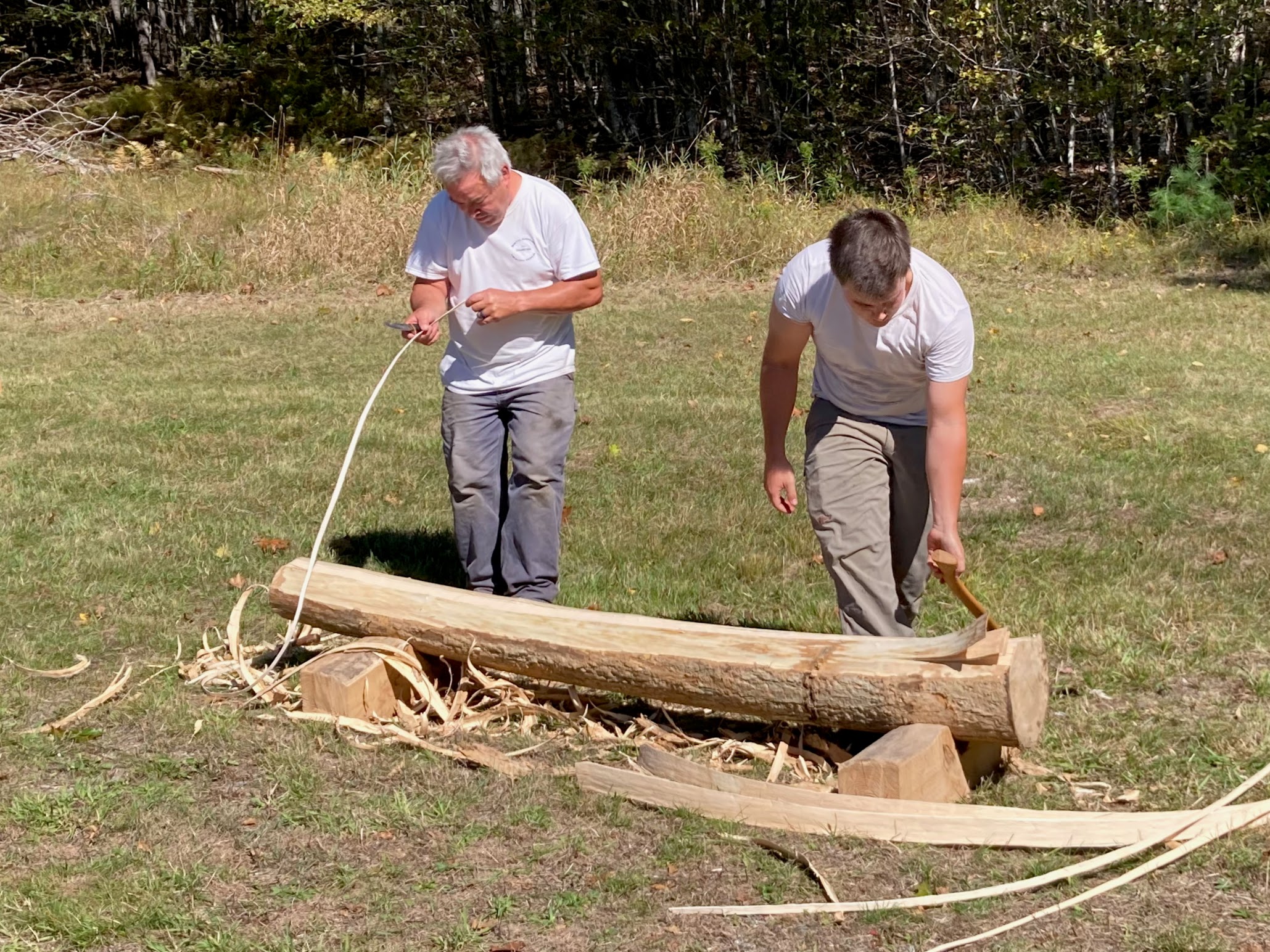
Butch and Ethan Jacobs removing splints from a brown ash log. Photo by Lauren Gonzalez
Preserving Ash, Protecting Traditions Workshop
September 27, 2025
By Zoe Albion
At the end of September, the Trust co-hosted a workshop in the Wildlands entitled “Preserving Ash, Protecting Traditions.” Why do ash trees and traditions in Maine need preserving and protecting? In addition to the threats of development and climate change, the Emerald Ash Borer (EAB) is changing the landscapes around us in more ways than one.
Emerald Ash Borer is an invasive insect first found in Maine in 2018 and has been spreading rapidly ever since. Killing trees in just a handful of years, EAB targets all three native species of ash in Maine, but brown ash is especially susceptible. Wabanaki identity is in close relationship with brown ash, and brown ash basketmaking is a critical cultural practice that is under threat from EAB. Many approaches and bodies of knowledge are needed for a collective response to EAB.
This event was organized by Ella McDonald, PhD student at the University of Maine APCAW lab (Ash Protection Collaboration Across Waponahkik) and featured demonstrations and talks about the many facets of ash preservation in Maine. After a welcome and opening from Ella and Trust director Landon Fake, Dr. John Daigle, director of the APCAW lab, provided a backdrop for the event. Holding baskets made by his grandfather, he spoke on Wabanaki cultural relationships to brown ash and the collaborative efforts to protect ash trees in Waponahkik.[1] Ella also provided an overview on ash and EAB, Director of the Maine TREE foundation Logan Johnson shared ash preservation values, Maine Inland Fisheries and Wildlife Forester Jack Chappen taught ash forestry and silviculture, and Urban Forestry Manager Ben Arruda discussed the City of Bangor’s Ash Management Plan. Allison Kanoti, Director of Forest Health and Monitoring at the Maine Forest Service, finished the series with an update on the Forest Service’s efforts to monitor and manage EAB across the state.
After lunch, Basketmakers Butch Jacobs, Ethan Jacobs, and Paula Love (with her husband and son) demonstrated ash pounding, the practice of processing felled brown ash trees into splints used for basketmaking. Peppering in stories and answering questions, Butch, Ethan, and Paula shared their knowledge as the sounds of ash pounding rang through the clearing, underscoring the importance of ash preservation and the tremendous cultural importance basketmaking and brown ash hold for the Wabanaki people. Finally, field trips commenced in the early afternoon. Jack Chappen, Ella McDonald, and Lewis Marston of Great Pond Trust taught ash identification, inventory, and seed collection on a short hike, while APCAW post-doctoral researcher Lauren Gonzalez offered roadside ash identification training. Allison Kanoti and APCAW Master’s student Zoe Albion trained participants in ash peeling on a tree from the Wildlands property that was used to monitor for EAB. Fortunately it contained no EAB larvae, a good sign that EAB may not be in the Wildlands yet, though it has recently been found on Mount Desert Island.
Over the course of this workshop, participants learned about the many ecological, cultural, and intrinsic values of brown ash trees, and some ways we can all work together to keep them on the landscape for as long as possible and help them regenerate as EAB moves through Maine.
Some key takeaways included:
- Brown ash is a keystone wetland tree species and its decline affects the entire ecosystem
- Anyone can monitor for EAB by looking for signs and symptoms, including excessive woodpeckering, a dying crown, and D-shaped exit holes in ash trees. Any findings, including the location and a picture, should be reported to the Maine Forest Service through their brief form at maine.gov/eab
- EAB moves furthest when it hitches a ride: move firewood as little as possible, and be mindful of the Forest Service quarantine. Ideally, move firewood no more than 10 miles from the tree it was cut from.
- There is hope for ash trees! Research into resistance breeding, biological control, lingering ash, and more, is ongoing and shows promise.
- Finally, brown ash is irreplaceable and it is our collective responsibility to do what we can for this unique tree
Thank you to everyone that participated in this workshop! Please stay in touch with APCAW by signing up for our newsletter, and visit our website for more information about protecting ash. You can report EAB or learn more about the state quarantine by going to www.maine.gov/eab.